City Park Apartments
Abstract Forest: Merging Symbolism, Light, and Urban Identity
Each city quarter functions as a self-contained urban pocket, a microcosm with its own spatial identity. Neighbouring urban blocks may feel like isolated worlds, yet their interconnections shape the character of the façades enclosing them.
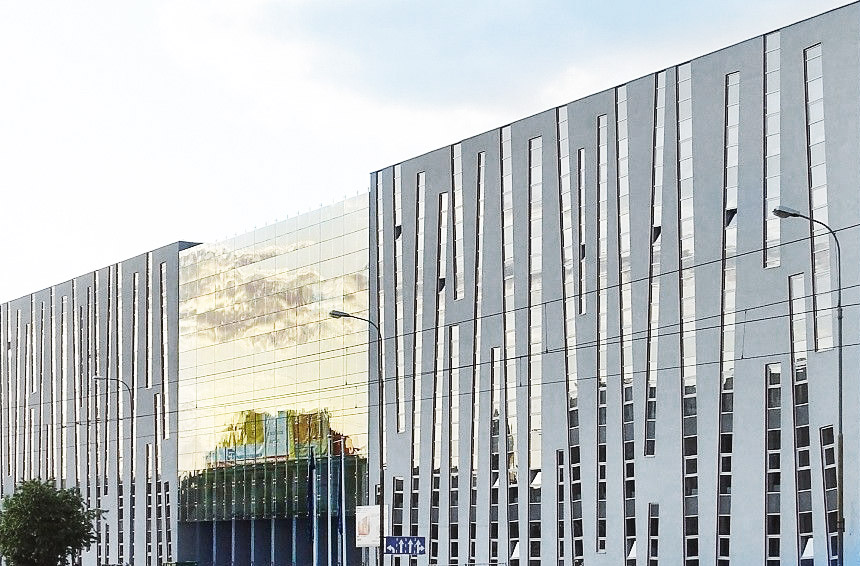
In Popowice City Park Apartments, this concept was translated into a simplified visual infographic, embedded into the architectural elements of the façade. The design aimed to communicate the essence of the urban fabric to the outside world, using a symbolic, large-scale architectural envelope as a storytelling medium. Through abstract symbolism and geometric language, the building itself became a marker of transformation, engaging both residents and the broader cityscape in a dialogue about urban identity and renewal.
Each city quarter functions as a self-contained urban pocket, a microcosm with its own spatial identity. Neighbouring urban blocks may feel like isolated worlds, yet their interconnections shape the character of the façades enclosing them.
In Popowice City Park Apartments, this concept was translated into a simplified visual infographic, embedded into the architectural elements of the façade. The design aimed to communicate the essence of the urban fabric to the outside world, using a symbolic, large-scale architectural envelope as a storytelling medium. Through abstract symbolism and geometric language, the building itself became a marker of transformation, engaging both residents and the broader cityscape in a dialogue about urban identity and renewal.
The elevation serves as a visual interface, an infographic façade that translates the essence of the building’s core into an architectural expression visible to the cityscape. It acts as a broadcasting layer, communicating the identity and purpose of the structure to its surroundings. Through abstract symbolism and geometric interpretation, the façade forms a synthesized pocket of forest-like patterns, creating a dialogue between architecture and nature, seamlessly integrating the building into the urban fabric.
The symbolic Forest on the elevation is merely a kaleidoscopic reflection of the birch-tree-enclosed courtyard parks within. These internal green pockets create an organized micro-forest, enriching the sustainable and healthy lifestyle of its inhabitants.
This inside-out design vision establishes a deliberate contrast between the outer envelope—defined by its raw, bold, and geometric cuts—and the inner sanctuary, which is soft, organic, and welcoming, shaped by natural elements. This duality embodies the building’s design strategy, where the façade becomes a canvas for expressing the architectural philosophy.
The elevation translates this concept into a schematic language of pictograms, serving as an urban-scale visual narrative. The façade itself becomes an urban pictogram, a symbol that communicates the essence of the building in a form both abstract and universally understood.
For a design concept to be truly meaningful, it must function within the pragmatic world. Without this foundation, it remains nothing more than a wishful vision or abstract fantasy, detached from the reality of architecture as an organized, built environment. The success of this project lies in its ability to merge conceptual expression with tangible execution, ensuring that ideas are not just symbolic gestures but functional, livable spaces that shape the urban experience.
Symbolism in architecture bridges ideas and physical expression, going beyond mere representation to embed deeper philosophical meaning into form.
In this project, birch trees are not simply depicted—they are abstracted into an ornamental façade, facing a major transportation axis within the structured grid of the urban block. This architectural gesture transforms the building into a symbol of an abstract urban forest, where a simple mass is enriched by varied fenestration angles, creating depth and dynamism.
Just as sunlight filters through a dense forest canopy, the interplay of cuts and reflections animates the façade, reinforcing the dialogue between nature and the built environment.
Ambience in architecture is not just about space—it is about the perception of space. In this project, reflection serves as a tool to dematerialize the building, allowing it to blend with its surroundings, shift perspectives, and create a dynamic relationship with light.
Here, the building itself becomes an expression of ambience, transforming its architectural language through a fusion of formal structure and abstract symbolism. The interplay of reflection, transparency, and surface articulation allows the architecture to go beyond mere physicality, dissolving into an atmospheric experience that evolves with time, movement, and light.
City Park Apartments
Abstract Forest: Merging Symbolism, Light, and Urban Identity